Text link
The text link component lets you add styled buttons or links to your CMS pages, with options for text, URL, style, and size.
What is the text link component?
The text link component lets you add styled buttons or links to your CMS pages. You can set the link text, URL, style, and size, and position the link using layout options.
Open the CMS editor where you want to add or edit a Text Link component.
Drag the text link component onto your page.
Enter the link text and URL, choose the style and size, and adjust positioning as needed.
Save your changes in the editor.
Please note in order for the text link component to work correctly you will need to ensure that you have the block type set to inline-block in the display settings. Text links can be positioned by placing them inside a empty block.
We can also add custom buttons to the text link component contact us to discuss.
Text link component settings
All text link components support the standard CMS settings below. Use these tabs to control layout, typography, and display for your text link:
Settings
URL
Enter the URL for the link.
Text
Enter the text for the link.
Target
Choose whether the link opens in the same tab or a new tab.
Button style
Choose the style for the link (e.g., primary, secondary, dark, light, link, warning).
Button size
Choose the size for the link (e.g., default small, large, extra small).
General
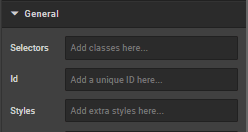
Selectors
In this box you can add classes that are defined elsewhere on the site to a specific page.
ID
ID is used to direct user to an element of the page or identify it for future use, so you can link to this aspect of the page.
Styles
Styles are used to add a specific style not predefined in a class. You can add style settings which can be applied against any component. Below are a list of styles you can add:
- Margin (either just
"margin:"or specific sides of a component like"margin-top:"or"margin-left:") - Padding (either just
"padding:"or specific sides of a component like"padding-top:"or"padding-left:") - Max Width
- Font
- Border
- ID
Examples:
max-width: 352px!important;
margin-bottom: 0 auto;
padding-top: 30px;
To center an image: margin:auto;
To center text/markdown: text-align: center;
To make a component go edge-to-edge: margin-left:-15px;margin-right:-15px
Typography
This section controls the text that appears on the page.
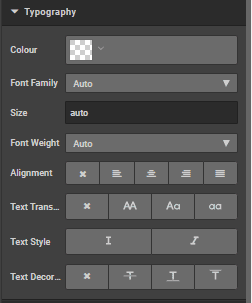
Colour
This box can be used to change the colour of the text. Use hex colour codes eg Red #ff0000 White #ffffff
Font family
Specify the font family or leave blank to automatically inherit the default page font
Size
Specify the size or leave blank to automatically inherit the default initial size
Weight
Specify the weight from the dropdown list, choose from 'light', 'normal' or 'bold' or select 'auto' to automatically inherit the default weight.
Alignment
Use icons to select the alignment choose from: 'no alignment', 'left align', 'centre align', 'right align' and 'justify' respectively
Text transform
Use icons to change the text from block capitals to lower case or title case or no transformation.
Text style
Use icons to choose from Italicised or not.
Text decoration
Use icons to choose from no decoration, strikethrough, underline or overline
Display
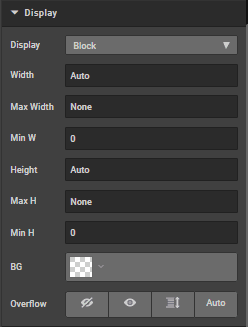
Display
Choose from the dropdown list to select display default is block, options are 'Flex', 'inline', 'none' and 'inline block'
Width
Specify a width
Max width
Specify a max width
Min width
Specify a min width
Height
Specify a height
Max height
Specify a maximum height
Min height
Specify a minimum height
BG
Change the background colour
Overflow
Chose from visible, not visible(icon) Scroll, scroll x
Spacing
Click on margins or borders to increase the margin or border by pixels
Borders
Click on borders to increase the border by pixels
How is this guide?
Last updated on